
Growing Healthy, One Germ at a Time
Why Kids Get Sick During Back-to-School Season–and How to Support Their Immune System Naturally
Written by Dr. Erica Brown, NMD
Every year it happens like clockwork.
The backpacks come out. School pictures get posted. Lunchboxes are packed. Then just a couple of weeks later, the tissues appear, the cough starts, and someone in the house is suddenly running a fever. Parents begin asking the same question: “Is something wrong with my child’s immune system?” If you’ve found yourself wondering the same thing, you’re certainly not alone. It’s one of the most common concerns I hear every within a few weeks of school starting.
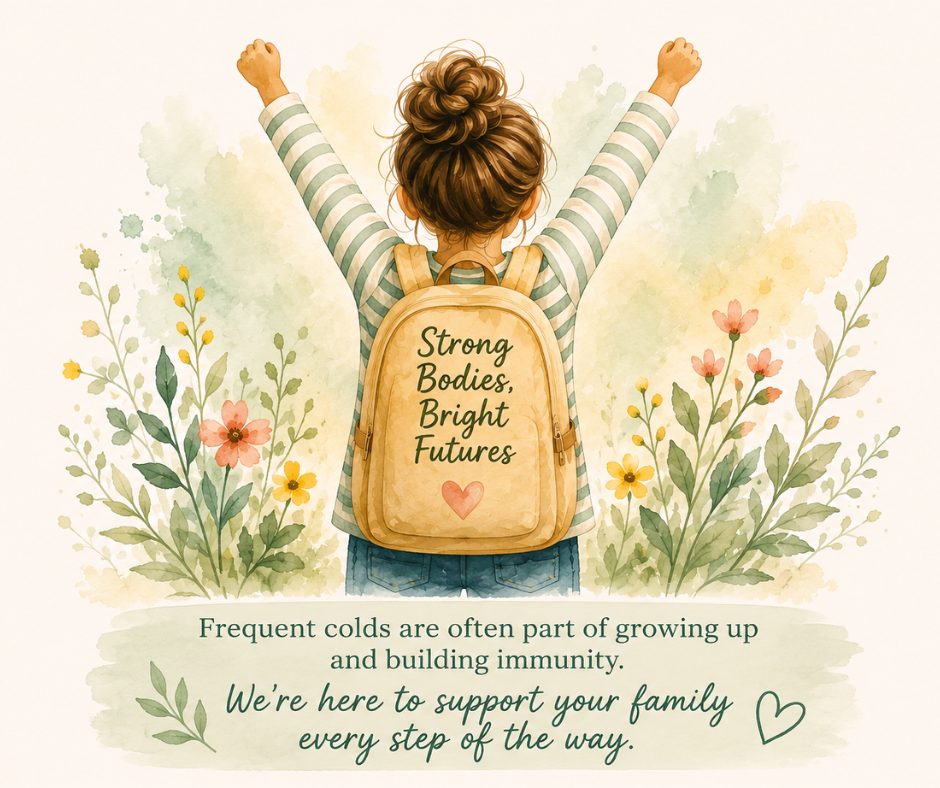
The reassuring news? For most children, the answer is no. In fact, frequent childhood illnesses are often a sign that the immune system is doing exactly what it’s designed to do: learning. Let’s take a look at why illnesses seem to explode when school starts, what truly supports a healthy immune system, and when recurrent illness deserves a closer look.
Why Do Kids Always Get Sick When School Starts?
This isn’t your imagination, and it isn’t bad luck. Researchers have consistently found that respiratory illnesses increase shortly after children return to school, usually within 2 to 4 weeks.1,2
The reason is fairly simple. During the summer, children tend to spend time in smaller social circles and outdoors. When school begins, hundreds of children suddenly gather indoors, sharing classrooms, playgrounds, sports equipment, and lunch tables. Every child brings their own collection of viruses, and those germs spread quickly. While it may feel like your child is sick constantly, this yearly “back-to-school bug season” is actually a normal part of childhood.
Frequent Colds Don’t Usually Mean a Weak Immune System
One of the biggest misconceptions I hear is: “My child must have a weak immune system.” More often than not, that’s simply not the case.
A young child typically experiences six to eight colds each year, while adults average two to four. And children in daycare or during their first few years of school may have even more.3 That number sounds surprising until you realize there are more than 200 viruses capable of causing the common cold. Recovering from one virus doesn’t provide protection against the next.
Instead of thinking about your child’s immune system as weak, it helps to think of it as under construction. Just like children don’t learn to read overnight, they don’t develop a fully experienced immune system overnight either. A kindergartener starts with letters before moving on to words, longer sentences, and eventually chapter books. The immune system develops much the same way. Each illness teaches the immune cells how to recognize a new virus, build memory, and respond more efficiently the next time. In other words, the immune system is being educated.
Research shows that many parts of the immune system continue maturing throughout childhood, which is why children who seem to catch every cold in preschool often become noticeably healthier during the elementary school years.4
So… Can We “Boost” the Immune System?
The truth is, we don’t actually want to boost the immune system. An immune system that’s too active can contribute to allergies and autoimmune disease. Instead, our goal is to support an immune system that is balanced, resilient, and able to respond appropriately when it’s needed. Fortunately, many of the most powerful ways to do that have nothing to do with expensive supplements.
1. Prioritize Sleep
If I could recommend just one lifestyle habit for supporting immune health, it would be sleep. During sleep, the body produces many of the immune signals and protective cells needed to fight infection. Research consistently shows that people who don’t get enough sleep become sick more often, and one study found that adults sleeping fewer than six hours per night were more than four times as likely to develop a cold after being exposed to a virus compared with those sleeping at least seven hours.5, 6
Children need considerably more sleep than adults, and the transition back to school often means earlier wake-up times and accumulated sleep debt. A few simple habits can make a big difference:
Keep bedtimes and wake times as consistent as possible–even on weekends.
Limit screens for at least an hour before bedtime.
Create a calm bedtime routine.
Make sleep a family priority, not an afterthought.
2. Nourish the Immune System Through Food
There isn’t a single “superfood” that prevents illness. Instead, healthy immune function depends on consistently providing the body with the nutrients it needs. Aim for meals that include:
Plenty of colorful fruits and vegetables.
Quality protein at every meal
Healthy fats like avocado, olive oil, nuts, seeds, and fatty fish
Whole-food carbohydrates for steady energy
Adequate hydration throughout the day
Rather than striving for perfection, focus on variety over time. A lunchbox doesn’t have to be Pinterest-worthy to nourish a growing immune system.
3. Get Outside Every Day
Outdoor play offers benefits that extend far beyond burning energy. Regular outdoor activity encourages movement, reduces stress, supports better sleep, and provides opportunities for healthy sun exposure, which helps the body produce vitamin D.
Whether it’s riding bikes, climbing at the playground, playing soccer, or simply taking an evening family walk, spending time outdoors is one of the simplest ways to support overall health.
4. What About Vitamin D?
Vitamin D is one of the most studied nutrients when it comes to immune health. It helps regulate immune function and supports the body’s natural defenses against respiratory infections. Recent clinical guidelines recommend ensuring children receive adequate vitamin D through safe sun exposure, fortified foods, or supplementation when needed–particularly for children who may not be getting enough through diet or lifestyle.7
While vitamin D isn’t a magic shield against every cold, maintaining healthy levels is an important part of overall wellness. More isn’t necessarily better, though. Like any nutrient, vitamin D should be taken in age-appropriate amounts, ideally with guidance from your healthcare provider.
5. When Can Supplements Be Helpful?
Parents often ask whether probiotics, elderberry, zinc, vitamin C, or other immune supplements can prevent every illness. The hones answer is: sometimes–but not always.
Some evidence suggests probiotics may modestly reduce the number of respiratory infections and the need for antibiotics in certain children. Zinc may be helpful for children who are deficient, while vitamin D is appropriate for many children who aren’t meeting their needs through diet or sunlight.8-10 But no supplement has been shown to outperform the basics:
Consistent sleep
Nutrient-dense diet
Regular physical activity
Good handwashing habits
Stay up to date on routine wellness visits
Supplements should complement these healthy habits–not replace them. Because every child is different, I prefer an individualized approach rather than recommending the same supplement for every family.
6. Don’t Forget the Simple Things
Sometimes the most effective strategies are also the least exciting. Regular handwashing with soap and water remains one of the simplest ways to reduce the spread of respiratory illnesses, especially after school, before meals, and after blowing noses or coughing. Studies continue to show that good hand hygiene reduces respiratory infections in both children and adults.11,12 Teaching children these habits early can make a meaningful difference–not only for them, but for the whole family.
When Should Frequent Illness Raise Concern?
Most children who seem to “catch everything” have completely healthy immune systems. However, there are times when recurrent illness deserves further evaluation. Talk with your child’s healthcare provider if your child:
Isn’t growing or gaining weight appropriately
Has severe or unusual infections
Develops recurrent pneumonia or other serious lower respiratory infections
Needs frequent IV antibiotics or prolonged antibiotic treatment
Has infections that keep occurring in the same location
Experiences chronic diarrhea or poor wound healing
Has a family history of immune deficiency
Sometimes children who appear to have recurrent infections actually have untreated allergies, asthma, enlarged adenoids, or other conditions that mimic frequent illness. If the overall pattern doesn’t seem typical, it’s always appropriate to ask questions.
Back-to-School Immune Support Checklist
As you prepare for another school year, remember that supporting the immune system doesn’t have to be complicated.
Prioritize consistent, age-appropriate sleep.
Offer balanced meals with protein, healthy fats, fiber, and colorful produce.
Encourage outdoor play and daily movement.
Practice good handwashing habits.
Make sure your child is getting enough vitamin D.
Talk with your healthcare provider before starting supplements.
Stay up to date on routine wellness visits.
The Bottom Line
Watching your child come home with “just another cold” can be frustrating–and exhausting. But for most children, those frequent sniffles aren’t a sign that something is wrong. They’re a sign that the immune system is doing one of its most important jobs: learning.
Rather than searching for a magic immune booster, focus on the foundations that truly matter–adequate sleep, nourishing food, outdoor play, healthy habits, and plenty of opportunities for growing bodies to rest and recover. Over time, those everyday habits help build something much more valuable than a quick fix: a resilient, well-regulated immune system that’s prepared for the years ahead.
And if your child’s illnesses ever seem more severe, more frequent, or simply different from what’s expected, don’t hesitate to reach out to your healthcare provider. Sometimes reassurance is exactly what’s needed–and sometimes a closer evaluation can provide important answers.
References:
1. Markovich P, et al. Pediatr Infect Dis J. 2015;34(5):476-481.
2. Temte JL, et al. Epidemiol Infect. 2019; 147:e127.
3. Heikkinen T, Jarvinen A. Lancet. 2003;361:51-59.
4. Koutsogiannaki S, et al. Clin Immunol. 2023;255:109728.
5. Robinson CH, et al. Fam Pract. 2021;38(6):802-810.
6. Prather AA, et al. Sleep. 2015;38(9):1353-1359.
7. Demay MB, et al. J Clin Endocrinol Metab. 2024;109(8):1907-1947.
8. Zhao Y, et al. Cochrane Database Syst Rev. 2022;8:CD006895.
9. Wang Y, et al. Medicine (Baltimore). 2016;95:e4509.
10. Lassi ZS, et al. Cochrane Database Syst Rev. 2016;12:CD005978.
11. Jefferson T, et al. Cochrane Database Syst. Rev. 2023;1:CD006207.
12. Ross I, et al. Lancet. 2023;401:1681-1690.